


Let's be honest - most of us don't think too hard about bathroom mirrors. You hang one up, glance at yourself in the morning, and move on. But if you've ever been in a beautifully designed bathroom with a sleek, glowing mirror and thought, "okay, that's kind of amazing," you already know the feeling we're talking about.
Right now, the LED mirror is having a serious moment. You see them everywhere - in hotels, home renovation shows, and Instagram bathroom makeovers. But are they actually useful, or just a fancy upgrade you don't really need?
That's exactly what we're going to break down in this guide. We'll compare LED mirrors to regular mirrors across every angle that matters - function, style, cost, and everyday use - so you can make the right call for your space and budget.
What Is an LED Mirror, Exactly?
An LED mirror is a mirror that has LED lights built into it, either around the edges, behind it, or embedded within the mirror surface itself. These lights are typically cool white, warm white, or neutral white, and many models let you adjust the brightness or color temperature depending on your needs.
Think of it this way: your standard bathroom vanity mirror just reflects your face. A bathroom mirror with light does that and acts as a dedicated lighting source - all in one piece. No extra fixtures, no guessing if the overhead light is washing you out.
They come in all kinds of shapes and sizes. You've got rectangular options, square frames, and then the super popular round LED mirror, which has become a go-to in modern and minimalist bathroom designs. You can find them as wall mirrors that mount flush or even as pivot-style options.
Regular Mirrors - Still a Solid Choice?
Regular mirrors aren't going anywhere. They're simple, affordable, and they get the job done. A classic bathroom vanity mirror or a set of wall mirrors can look great in the right space, especially if you're going for a traditional or rustic style.
Bathroom pivot mirrors are a great example. They tilt and adjust to your angle, which is genuinely useful if you're short, tall, or just like checking different angles when you get ready. They've been a bathroom staple for decades for a good reason.
Standard mirrors are also dead simple. No wiring, no switches, no batteries. If the power goes out, your mirror still works. There's something to be said for that.
But here's where regular mirrors fall short: lighting. Most bathrooms have overhead lighting, which casts shadows downward across your face. That means you're applying makeup or shaving in less-than-ideal conditions without even realizing it. Good lighting changes everything.
LED Mirror vs. Regular Mirror: A Real-World Comparison
1. Lighting Quality
This is the biggest win for LED mirrors, hands down. The built-in LED lighting in a bathroom mirror with light provides even, shadow-free illumination right at eye level. That's the sweet spot for getting ready - whether you're putting on mascara, trimming a beard, or just making sure your collar is straight.
Regular mirrors rely entirely on your existing bathroom lighting, which is often overhead and unflattering. If your bathroom has poor lighting, a regular mirror won't fix that.
Winner: LED Mirror - it gives you the kind of lighting that actually helps.
2. Style and Aesthetics
If you want that high-end, spa-like bathroom vibe, LED mirrors are tough to beat. The glow around a round LED mirror or a large rectangular backlit mirror instantly elevates the whole room. It looks intentional and polished in a way that's hard to achieve with a plain mirror.
That said, if you have a farmhouse, cottage, or vintage bathroom, luxury bathroom mirrors in traditional finishes - like brass, matte black, or antique silver - can look way more fitting than anything with LEDs.
Winner: Depends on your bathroom style. LED wins in modern spaces; traditional mirrors win in classic settings.
3. Price and Budget
Let's talk money. A decent regular mirror can cost you anywhere from $20 to $150, depending on size and frame. Simple, no surprises.
The best bathroom LED mirrors start around $80 to $150 for basic models, and go up to $400 or more for large, feature-rich options. Luxury bathroom mirrors with built-in dimmers, anti-fog features, and touch controls can run even higher.
However, when you factor in that you're essentially replacing a mirror AND a light fixture with one product, the value starts to make more sense. You're simplifying your bathroom setup while getting better lighting.
Winner: Regular mirrors on upfront cost. LED mirrors have long-term value.
4. Installation
Regular wall mirrors are easy to hang. Most of them just need a couple of anchors and a level - you could do it in 20 minutes on a Saturday morning.
LED mirrors need to be wired into your bathroom's electrical system, which usually means hiring an electrician if you don't have an outlet already located near your mirror space. Some plug-in models exist, but hardwired installations look much cleaner.
If you're doing a full bathroom remodel, this is the perfect time to add an LED mirror - the electrical work is already being done. If you're just doing a quick refresh, the added installation cost might give you pause.
Winner: Regular mirrors for ease of installation.
5. Anti-Fog and Smart Features
Here's something a regular mirror absolutely cannot do: defog itself. Many LED mirrors come with a built-in heating pad on the back that prevents fog from building up after a hot shower. If you've ever stumbled out of the shower and had to wipe the mirror with your hand, you know how annoying that gets.
Beyond anti-fog, a lot of the best bathroom LED mirrors come with touch-sensitive dimmer switches, color temperature controls (so you can switch between warm light for relaxing and cool light for applying makeup), built-in clocks, Bluetooth speakers, and even magnifying sections.
A regular bathroom vanity mirror offers none of that. It reflects. That's it.
Winner: LED Mirror by a mile.
6. Durability and Maintenance
LED lights are rated for anywhere from 30,000 to 50,000 hours of use. If you use your mirror for about two hours a day, that's potentially 40 to 68 years of light life. You're not going to be replacing bulbs.
Regular mirrors can last indefinitely as long as they don't get cracked. There's nothing to break down electrically. But they also don't improve over time - they just keep reflecting.
Winner: Tie. Both can last a very long time with basic care.
Which One Works Best for Your Bathroom Type?
Not every bathroom is the same, and the right mirror depends a lot on your specific setup.
• Small bathrooms: A round LED mirror works great here. The circular shape softens a tight space, and the lighting makes the room feel brighter and larger without adding extra fixtures.
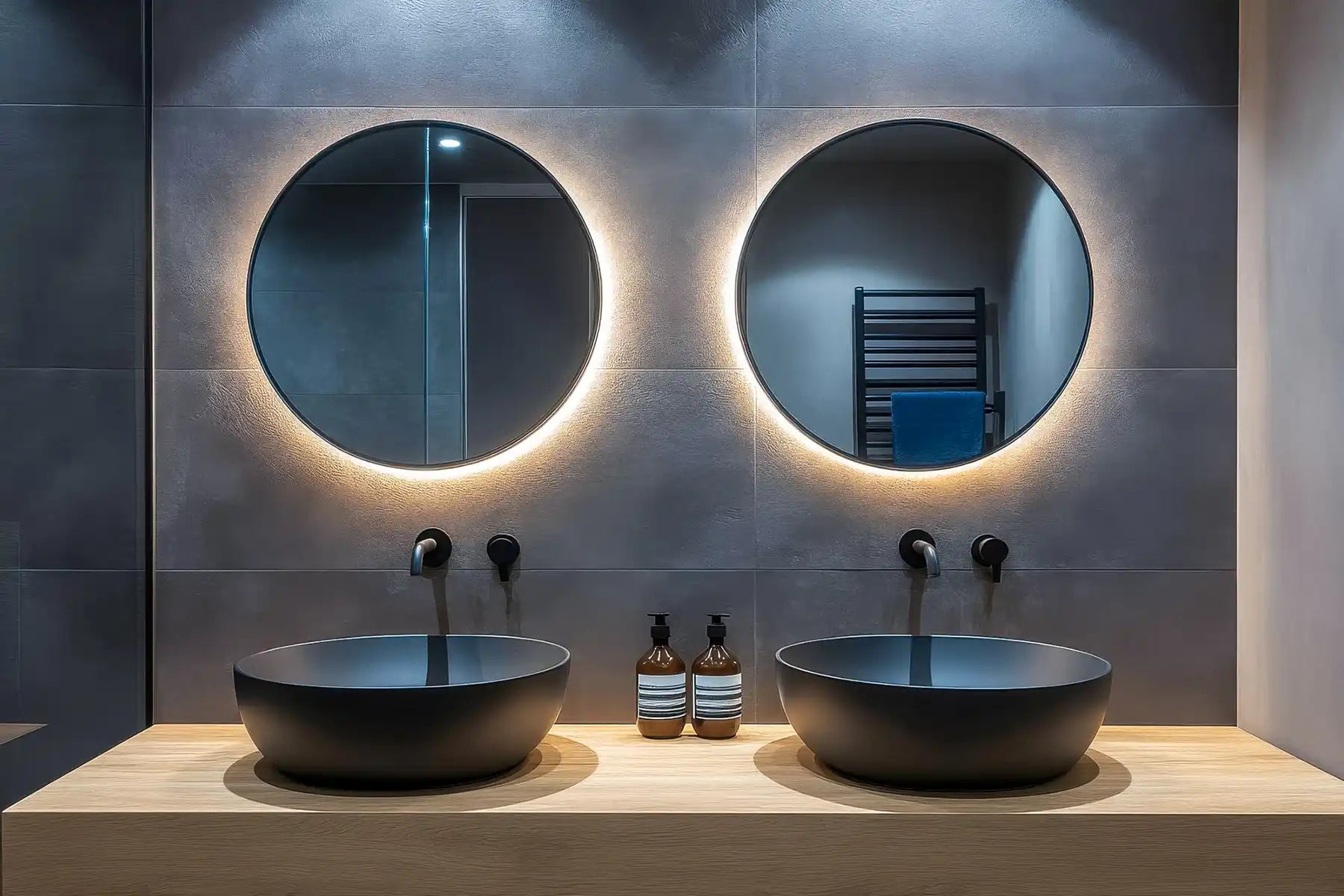
• Double vanity bathrooms: Two large bathroom vanity mirrors with LED lighting on either side of a double sink look stunning and very intentional. This is where LED mirrors really earn their place.
• Guest or half bathrooms: A simple, stylish wall mirror is often fine here. Guests don't need anti-fog or dimmers - they just need to see their reflection.
• Master bathrooms: This is your space for luxury bathroom mirrors. If there's ever a room worth investing in, it's the one you use every single day. A large LED mirror here pays off in daily comfort and home value.
• Adjustable-angle needs: If you need to tilt your mirror to see different angles, bathroom pivot mirrors are still a great functional option, and some LED pivot models now exist, too.
Most Popular LED Mirror Styles Right Now
Round LED Mirror
A round LED mirror is probably the most popular pick right now, and it makes sense why. The circle shape feels organic and relaxed, which balances out the hard angles you often find in modern bathrooms - square tiles, rectangular sinks, straight lines everywhere. Add some backlit glow, and you've got a focal point that people notice instantly.
Rectangular Backlit Mirror
These are ideal over double vanities or in bathrooms with a more structured, architectural look. A long rectangular LED mirror over a wide bathroom vanity mirror space looks clean, upscale, and hotel-inspired. If you're going for that high-end feel, this is the format to go with.
Frameless LED Wall Mirrors
Frameless wall mirrors with backlight are perfect for minimalist bathrooms where you want the mirror itself to disappear and only the light to show. They look incredible in all-white or neutral-toned bathrooms.
So, Are LED Mirrors Worth It?
Here's the bottom line: if you care about good lighting when you get ready, want to upgrade how your bathroom feels, and are okay with a slightly higher upfront cost, yes - an LED mirror is absolutely worth it.
They're especially worth it in master bathrooms and primary vanity areas where you spend real time getting ready every day. The combination of built-in lighting, clean design, and features like anti-fog makes them genuinely functional, not just decorative.
That said, a standard mirror is still a completely solid choice for guest bathrooms, rentals, or spaces where simplicity and budget are the main priorities. The best bathroom LED mirrors shine brightest in the rooms where people actually use them daily.
If you're on the fence, consider starting with a single round LED mirror in your main bathroom. It's a low-commitment way to experience the difference. Chances are, once you've gotten ready with good, even, face-level lighting, going back to a plain wall mirror and harsh overhead light is going to feel like a real step backward.
Your bathroom is a space you use every single day. A little upgrade there can genuinely change how your mornings feel - and that's worth something.


